- English
- Español
- Português
- русский
- Français
- 日本語
- Deutsch
- tiếng Việt
- Italiano
- Nederlands
- ภาษาไทย
- Polski
- 한국어
- Svenska
- magyar
- Malay
- বাংলা ভাষার
- Dansk
- Suomi
- हिन्दी
- Pilipino
- Türkçe
- Gaeilge
- العربية
- Indonesia
- Norsk
- تمل
- český
- ελληνικά
- український
- Javanese
- فارسی
- தமிழ்
- తెలుగు
- नेपाली
- Burmese
- български
- ລາວ
- Latine
- Қазақша
- Euskal
- Azərbaycan
- Slovenský jazyk
- Македонски
- Lietuvos
- Eesti Keel
- Română
- Slovenski
- मराठी
- Srpski језик
- שפה עברית
- беларускі
- Bosanski
- ქართული
- O'zbek

New National Standards Take Effect, Market Size Surges – What's Happening in the Fuse Industry?
As 2026 reaches its midpoint, the fuse industry is experiencing a period of intense policy restructuring and market acceleration. From mandatory certification upgrades to the implementation of multiple national standards, and from surging global market size to new product innovations, the industry is undergoing a profound transformation. This article provides a comprehensive overview of the most impactful policy developments, market data, and product innovations in the fuse industry during the first half of 2026.
I. Policy Front: Mandatory Certification Tightens, Multiple National Standards Take Effect
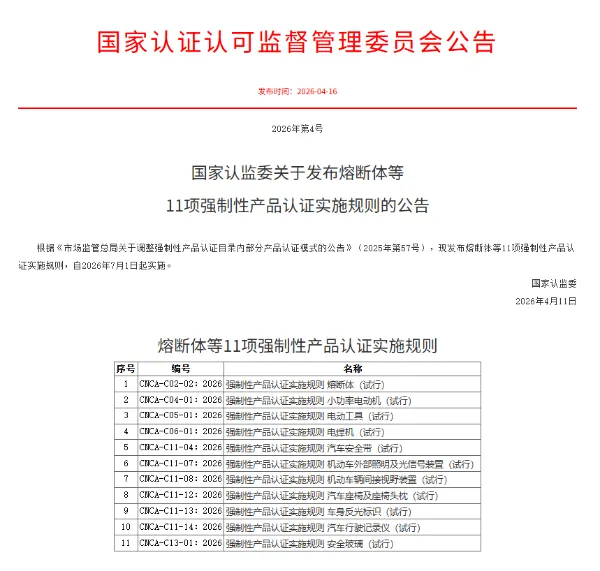
1. Fuse CCC Certification Transitions from Self-Declaration to Mandatory Status
In April 2026, the Certification and Accreditation Administration of China (CNCA) issued Announcement No. 4 of 2026, specifying that 11 product categories—including fuses—would transition from self-declaration to compulsory CCC certification. Effective July 1, 2026, designated certification bodies began accepting CCC certification applications for fuses, and new products are no longer eligible for self-declaration. Enterprises must complete certificate conversion by December 31, 2026, and from July 1, 2027, uncertified products will be prohibited from manufacturing, sale, and import. This adjustment covers all fuse categories, including low-voltage, photovoltaic, energy storage, charging station, and small surface-mount fuses—both domestic sales and export products must comply.
2. Two Mandatory Electric Vehicle Safety Standards Take Effect July 1
Effective July 1, 2026, the mandatory national standards GB 38031-2025 (Safety Requirements for Traction Batteries of Electric Vehicles) and GB 18384-2025 (Safety Requirements for Electric Vehicles) officially came into force.
Key changes introduced by the new regulations include: the battery safety evaluation standard has been upgraded from "5-minute warning after thermal runaway" to "no fire or explosion during a minimum 2-hour observation period following thermal runaway"; vehicles are now required to be equipped with an independent mechanical physical disconnection device, making high-voltage physical disconnection a mandatory compliance requirement; and two new rigorous tests have been added—bottom impact testing and short-circuit testing after fast-charging cycles—which more closely reflect real-world usage scenarios. For 800V high-voltage platforms and high-power fast-charging systems, the new regulations mandate the use of high-voltage fuses and trigger fuses, with significantly tightened thermal tolerance and interrupting capacity requirements for fuses.
3. National Standards Framework Continues to Evolve, China Leads International Standard Development
GB/T 13539.7-2024 (Low-voltage Fuses – Supplementary Requirements for Fuse-links for the Protection of Batteries and Battery Systems) has been fully implemented, adopting IEC 60269-7 to harmonize fuse testing standards for energy storage and traction battery applications. Concurrently, the revised edition of Low-voltage Fuses – Part 1 is under development, aligned with IEC 60269-1:2024, with upgraded requirements for DC 1500V and high interrupting capacity.
Notably, on June 3, 2026, the international standard Miniature Fuses – Part 4: Universal Modular Fuse-links (UMF) – Through-hole and Surface Mount Types, led by China in its revision, was officially approved and published.
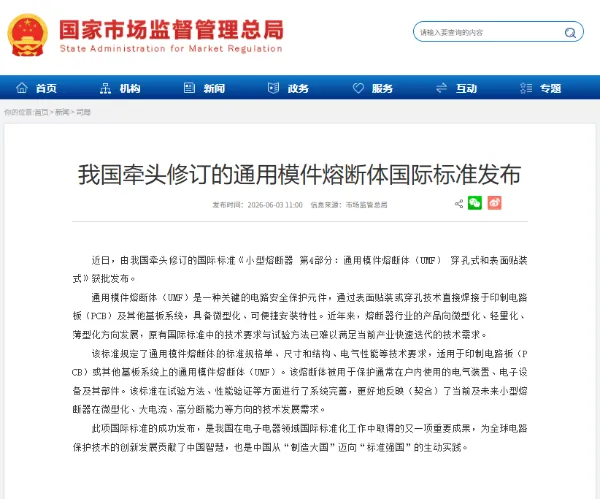
The standard specifies technical requirements for universal modular fuse-links, including specification sheets, dimensions, construction, and electrical performance. China has achieved a transformation from standard implementer to standard setter in this field.
II. Market Front: Scale Breakthroughs and Segment Growth (2026 Forecasts)
1. China Market: RMB 2.96 Billion, Up 24% YoY
Industry estimates project China's fuse market size will reach RMB 2.96 billion in 2026, representing 24.0% year-on-year growth. New energy vehicles and energy storage together contribute more than 50% of market growth. Among these, 800V automotive-grade trigger fuses are expected to account for 21% of the high-voltage fuse market, with active fuse products growing at over 60%, increasingly replacing traditional passive fuses as standard equipment in high-end vehicle models.
2. Global Market: $9.83 Billion, Asia-Pacific Accounts for 43.6%
The global fuse market is projected to exceed $9.83 billion in 2026, up 7.2% from 2025. The Asia-Pacific region contributes 43.6% of the global total, with continued expansion in new energy generation and EV infrastructure across China, India, and Southeast Asian nations serving as the core engine of global demand growth.
3. Energy Storage Fuses: $1.85 Billion, Growth at 30.3%
The energy storage sector maintains strong momentum. The global energy storage fuse market is expected to reach $1.85 billion in 2026, up 30.3% year-on-year. 1500Vdc and 2000Vdc high-voltage energy storage fuses command significant price premiums, with both volume and pricing rising in tandem.
4. Charging Station Fuses: 22% Annual Growth, Certification Thresholds Rise
Alongside the proliferation of 60kW to 480kW high-power ultra-fast chargers, demand for DC charging station fuses is growing at 22% annually. Beginning August 2026, complete charging station units will be included in the CCC mandatory certification scope, with fuses—as critical safety components—facing higher certification barriers.
III. Product Front: Purpose-Built for Ultra-Fast Charging and Energy Storage – Galaxy Fuse Full-Series Product Overview
Driven by both policy and market forces, Galaxy Fuse offers a comprehensive DC fuse portfolio covering high-power ultra-fast charging and commercial & industrial (C&I) energy storage applications. The full series holds UL, TUV, CCC, and CE automotive-grade certifications, providing a one-stop solution that meets both China grid-connection and export compliance requirements.
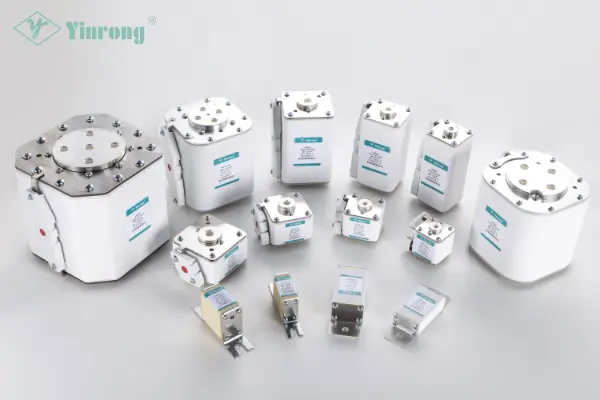
Product Application Scenarios: 60kW–480kW 800V liquid-cooled ultra-fast chargers, C&I energy storage PCS, battery cluster high-voltage circuits, and integrated PV-storage-charging systems.
Key Technical Specifications:
●Voltage Coverage: 32VDC–1500VDC full series
●Interrupting Capacity: Up to DC250kA
●Fusible Element Material: Proprietary silver-plated copper strip elements—silver's conductivity is 1.6 times that of copper, ensuring microsecond-level response
●Insulation Body: 95% high-purity alumina ceramic, offering high-temperature tolerance and thermal shock resistance
●Arc-Quenching Process: Vacuum-like curing process combined with high-purity quartz sand, achieving millisecond-level DC arc extinction
With over 40 years of fuse R&D and manufacturing expertise, Galaxy Fuse benchmarks every step—from material formulation and structural design to arc-quenching processes—against international industry leaders. To address the arc-extinction challenge posed by the absence of a natural zero-crossing point in high-voltage DC systems, Galaxy Fuse employs optimized necked-structure design and proprietary arc-quenching curing technology, ensuring reliable interruption under extreme fault conditions and eliminating the risk of arcing and fire at the source.
Final Thoughts
2026 is a "year of compliance" and a "year of breakout" for the fuse industry. CCC certification has been significantly tightened, two electric vehicle national standards have taken effect, and China has taken the lead in developing the UMF international standard—these regulatory shifts are reshaping industry entry barriers. At the same time, the $9.83 billion global market size, the energy storage segment's 30.3% growth, and the 22% annual growth rate for charging station fuses all underscore the robust demand for high-quality fuses in the new energy sector.
Compliance thresholds are rising, market space is expanding, and product standards are being upgraded. For professionals in charging stations, energy storage, inverters, and lithium battery PACKs, choosing a fuse supplier that offers full-series certification, full-scenario coverage, and fully in-house R&D capabilities is no longer an option—it's a necessity.
Galaxy Fuse—over 40 years of dedication to high-quality fuses, with a full-series automotive-grade certification portfolio and comprehensive product matrix, building a safety shield for new energy equipment worldwide.
For technical support on DC fuse selection for energy storage systems, charging stations, or PV inverters, please contact the Galaxy Fuse technical team.