- English
- Español
- Português
- русский
- Français
- 日本語
- Deutsch
- tiếng Việt
- Italiano
- Nederlands
- ภาษาไทย
- Polski
- 한국어
- Svenska
- magyar
- Malay
- বাংলা ভাষার
- Dansk
- Suomi
- हिन्दी
- Pilipino
- Türkçe
- Gaeilge
- العربية
- Indonesia
- Norsk
- تمل
- český
- ελληνικά
- український
- Javanese
- فارسی
- தமிழ்
- తెలుగు
- नेपाली
- Burmese
- български
- ລາວ
- Latine
- Қазақша
- Euskal
- Azərbaycan
- Slovenský jazyk
- Македонски
- Lietuvos
- Eesti Keel
- Română
- Slovenski
- मराठी
- Srpski језик
- שפה עברית
- беларускі
- Bosanski
- ქართული
- O'zbek

After a BESS Fire, You Finally Realize aR and gG Are Not the Same Thing
For business owners, engineers, and procurement professionals working in charging stations, energy storage systems, inverters, and lithium battery packs, there's a painfully familiar scenario: to cut component costs, the procurement team goes with the cheaper option—abandoning dedicated aR fast-acting fuses in favor of low-cost, off-the-shelf gG slow-blow fuses.
The price difference is barely a few dozen yuan per unit. On paper, costs come down. But when a short circuit occurs in the field after batch delivery, the math flips—repairs, power module replacements, customer compensation, and downtime losses add up to tens of thousands of yuan. In worst-case scenarios, the entire energy storage container goes up in flames. This is not an exaggeration.
A Single Fuse Oversight Can Put an Entire Energy Storage Project at Risk
In May 2026, a battery energy storage system fire broke out at the Ruffs Lane coal mine site near Rainworth, Nottinghamshire, UK. Thick black smoke billowed from two stacked storage containers, both engulfed in flames. The facility, rated at 7.5MW/7.5MWh, was supplied with LG batteries and commissioned in 2017—it was the seventh grid-scale BESS to enter operation in the UK.
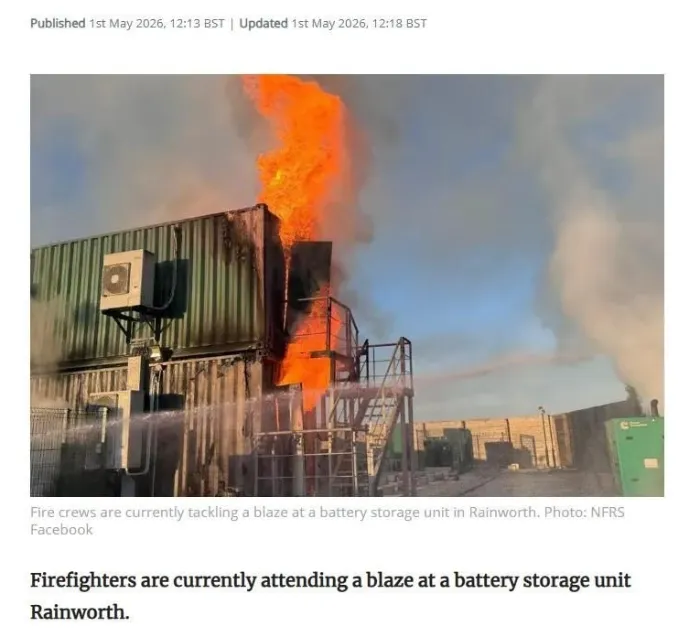
While the official cause is still under investigation, industry insiders know the pattern all too well: BESS fires are almost always linked to electrical protection failures. Short-circuit currents in battery clusters feature high DC voltage, massive current magnitude, and no natural zero-crossing point. When protection devices are underspecified or of substandard quality, fault currents cannot be cleared in time. Heat builds up, and the result is a chain reaction—container after container catching fire.
A fuse that costs a few dozen yuan can lead to the complete loss of a BESS, months of downtime, hefty compensation claims, and long-term brand damage. Is that a trade-off worth making?
Many Fail to Distinguish Between gG Slow-Blow and aR Fast-Acting Fuses
The widespread misconception is simple: "They're both fuses—if the current rating matches, it'll work."
The gG fuse was originally designed for low-voltage distribution panels and cable overload protection in residential and light-commercial AC applications—low current, low fault energy scenarios. Installing it in a DC charging station or energy storage system is like asking a general practitioner to perform emergency cardiac surgery. The mismatch exposes two critical flaws:
Slow Response Fails to Intercept High Short-Circuit Currents
IGBTs and SiC power devices inside charging stations and energy storage systems are extremely fragile. At the moment of a short circuit, massive surge currents can destroy the module in microseconds. A gG fuse has a long arcing time, allowing an enormous amount of fault energy (I²t) to pass through. By the time the fuse finally clears the fault—if it ever does—the expensive power module is already destroyed, contactor contacts are welded shut, and arcing often ignites surrounding materials.
Insufficient DC Arc-Quenching Capability
Direct current has no natural zero-crossing point, making arc extinction inherently difficult. Standard gG fuse elements contain only loosely filled quartz sand, without professional arc-quenching compound or curing processes. Under high-voltage DC short-circuit conditions, the arc cannot be extinguished quickly, leading to ruptured housings, sand leakage, and ignition of internal cabling—all classic precursors to BESS container fires.
What Actually Sets Galaxy Fuse aR Semiconductor Fast-Acting Fuses Apart from gG?
Galaxy Fuse high-speed fuses, purpose-built for DC charging stations, energy storage, and inverters, outperform ordinary gG products across materials, manufacturing processes, and performance:
Precisely Controlled I²t Prioritizes Protection of Core Components
Galaxy Fuse utilizes pure silver or silver-plated copper fusible elements—silver's conductivity is 1.6 times that of copper, delivering significantly faster response. By precisely limiting the let-through I²t value, fault energy is absorbed and the circuit is cleared within milliseconds, minimizing thermal stress on IGBTs and SiC devices and preserving expensive power semiconductors.
Silver-plated construction also provides superior resistance to metal fatigue and corrosion. With equipment cycling on and off daily through repeated charge/discharge operations, the fuse remains reliable over the long term without nuisance tripping.
Premium Materials Engineered for Demanding High-Temperature Environments
The fuse body uses 95% high-purity alumina ceramic, rejecting the low-cost 75% ceramic commonly found in the industry. This ensures high-temperature tolerance, thermal shock resistance, and stable insulation even in sealed enclosures or prolonged outdoor solar exposure. High-power series utilize pure copper terminals (at twice the cost of brass), delivering lower temperature rise under full-load operation and eliminating contact overheating, arcing, and pitting.
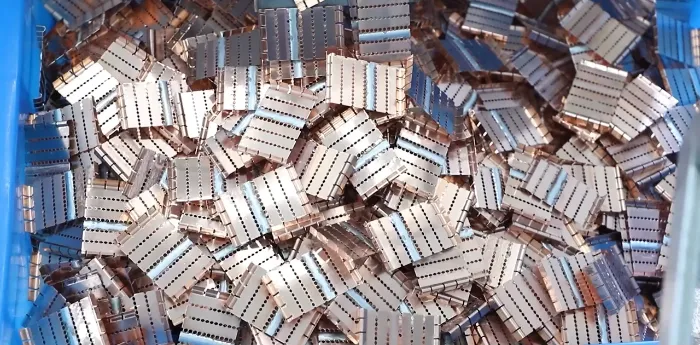
Automotive-Grade Arc-Quenching Curing Process
The majority of generic gG fuses are simply filled with loose quartz sand, skipping the curing step entirely. Galaxy Fuse employs high-purity quartz sand combined with a specialized arc-quenching compound, followed by an 8-hour high-low temperature cycling curing process. The result is a uniformly dense, integrated filler that rapidly suppresses arcs during short-circuit events, ensuring no housing rupture, no sand leakage, and fundamentally eliminating fire risk under high interrupting capacity conditions.
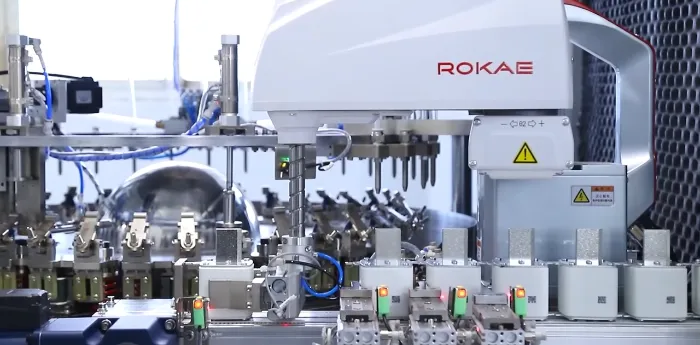
Full Voltage and Interrupting Capacity Coverage for High-Voltage Trends
Galaxy Fuse high-speed fuse series cover 750V, 1000V, and 1500VDC, with interrupting capacity up to DC250kA. This spans the full spectrum from standard DC chargers to 800V ultra-fast charging stations and large-scale C&I energy storage systems. All series hold UL, TUV, CE, and CCC certifications, simplifying approvals for both domestic and export projects.
A Trusted Industry Partner: Galaxy Fuse—Over 40 Years of Excellence
Established in 1980, Zhejiang Galaxy Fuse Co., Ltd. is a professional fuse manufacturer integrating R&D, testing, manufacturing, and sales. The company is recognized as a key enterprise under the former Ministry of Machinery Industry and a leading domestic fuse producer.
Core Technical Capabilities:
●48+ utility and invention patents in fuse manufacturing; recognized as a National High-Tech Enterprise in 2017
●Certified management systems: IATF16949, ISO9001, ISO14001, and ISO45001
●Products comply with GB13539, IEC60269, VDE0636, and other international standards
●Exported to over 80 countries and regions, including Europe, the US, and Africa
High-Speed Fuses for Energy Storage Systems are a key focus area for Galaxy Fuse. Addressing the stringent demands of BESS applications—DC voltages up to 1500V, short-circuit currents reaching hundreds of kiloamperes, and the need for absolute arc-extinction reliability in enclosed battery environments—Galaxy Fuse energy storage series products employ pure silver fusible elements and high-purity quartz sand arc-quenching media, combined with optimized necked structure designs. This ensures microsecond-level response and reliable interruption under extreme fault conditions.
Final Thoughts
A difference of a few dozen yuan per unit is negligible in the total cost of a charging station or energy storage system. But what it protects is the most expensive component in the entire system—the power semiconductors—and ultimately, the asset's reliability over its entire service life.
The Nottingham BESS fire serves as a sobering reminder: a seemingly insignificant component can become the weakest link in the entire safety chain when a fault occurs. Energy storage and charging infrastructure are fundamentally different from general power distribution. High DC voltage, massive short-circuit currents, and the absence of natural zero-crossing demand rigorous selection, precise I²t coordination, and uncompromising quality control.
What truly costs you isn't a properly specified fast-acting fuse—it's the slow-blow fuse you hoped would never have to work.
Galaxy Fuse has dedicated over 40 years to high-quality fuse development, from material formulation and structural design to arc-quenching processes—every step bench marked against international industry leaders. Across charging stations, BESS power conversion systems, and photovoltaic inverters, Galaxy Fuse high-speed fuses have been deployed in numerous projects worldwide, proven through large-scale deliveries and long-term field operation.
Safety is not an area for compromise. For technical support on fuse selection for energy storage or charging infrastructure—from I²t coordination to complete system protection solutions—contact the Galaxy Fuse technical team. We provide end-to-end engineering support throughout your project journey.