- English
- Español
- Português
- русский
- Français
- 日本語
- Deutsch
- tiếng Việt
- Italiano
- Nederlands
- ภาษาไทย
- Polski
- 한국어
- Svenska
- magyar
- Malay
- বাংলা ভাষার
- Dansk
- Suomi
- हिन्दी
- Pilipino
- Türkçe
- Gaeilge
- العربية
- Indonesia
- Norsk
- تمل
- český
- ελληνικά
- український
- Javanese
- فارسی
- தமிழ்
- తెలుగు
- नेपाली
- Burmese
- български
- ລາວ
- Latine
- Қазақша
- Euskal
- Azərbaycan
- Slovenský jazyk
- Македонски
- Lietuvos
- Eesti Keel
- Română
- Slovenski
- मराठी
- Srpski језик
- שפה עברית
- беларускі
- Bosanski
- ქართული
- O'zbek

Fast-Acting Fuse vs. Ordinary Fuse: What’s the Real Difference?
In power electronic system design, fuse selection directly determines equipment safety margins and the effectiveness of fault protection. When faced with fast-acting fuses versus ordinary fuses, many engineers make rough choices based solely on rated current and voltage, overlooking fundamental differences in material science, response mechanisms, and application scenarios. This oversight can pose serious risks in new energy and energy storage systems.
This article provides a systematic analysis of the core differences between fast-acting fuses and ordinary fuses—from structural design and fusing mechanisms to application boundaries—to help engineers make accurate selection decisions.
Structure and Materials: From "Metal Wire" to "Precision Fusible Element"
The fusible element of an ordinary fuse is typically made of geometrically shaped metal wire, featuring a simple structure and low manufacturing cost. Its fusing logic relies on Joule heat generated by the overload current itself; when heat accumulation reaches the melting point, the element melts and opens the circuit. This design makes it suitable for scenarios where rapid response is not critical, such as overload protection for cables and wires.
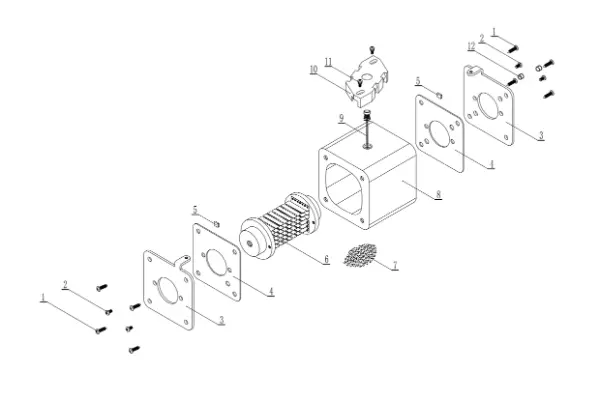
The fast-acting fuse, however, is specially optimized in both material and structure. Its fusible element is made of pure silver, silver-plated copper, or pure copper, shaped as a rectangular thin strip with narrowed circular-hole necks, and pre-positioned low-melting-point solder spots at specific locations. The ingenuity of this design lies in the fact that when an overload or low-multiple short-circuit current occurs, the solder spot melts first, and through a metallurgical effect, accelerates the rapid severance of the element at the narrowed neck, achieving circuit interruption in microseconds to milliseconds.
In essence, ordinary fuses rely on "natural heat accumulation," while fast-acting fuses achieve "active accelerated breaking" through structural and material engineering—this is the most fundamental difference between the two.
Response Speed: The Millisecond vs. Microsecond Gap
Response speed is the most intuitive differentiator between the two fuse types.
For ordinary fuses, the fusing time is inversely proportional to the overload current multiple: the higher the current exceeding the rated value, the shorter the fusing time; conversely, at lower overload multiples, the fusing time may extend to several seconds or even longer. This "time-delay" characteristic is acceptable in cable protection because cables have a certain thermal capacity and short-term overload capability.
Fast-acting fuses behave completely differently. Thanks to the "accelerating" mechanism of low-melting-point solder spots and the current-density concentration effect of the narrowed neck structure, fast-acting fuses can clear the circuit within milliseconds or even microseconds. This extreme speed is not pursued for its own sake but to remove fault current within the time limit that semiconductor devices (such as IGBTs, SiC MOSFETs, and rectifier diodes) can withstand—semiconductor thermal tolerance is typically only on the order of milliseconds, and ordinary fuses cannot meet this protection requirement.
Application Scenarios: Protection Targets Define Selection Logic
The application boundaries of fast-acting and ordinary fuses are naturally defined by their respective response characteristics.
Ordinary fuses are primarily used for overload and short-circuit protection of cables and wires. Cables possess a certain thermal inertia; short-term overloads do not immediately cause insulation damage, so a certain delay in fuse operation is permissible. This explains why ordinary fuses remain widely used in building distribution and industrial power lines.
Fast-acting fuses, on the other hand, are designed to protect semiconductor power devices and rectifier assemblies. In photovoltaic inverters, DC charging stations, and energy storage converters (PCS), IGBT and SiC modules are extremely vulnerable to overcurrent—once a short circuit occurs, the current must be cleared within hundreds of microseconds, or the device will be permanently damaged. Fast-acting fuses are precisely the solution for this requirement.
Particularly in energy storage systems (ESS), the application of high-speed fuses is critical. Short-circuit currents in battery clusters feature high DC voltage, high current magnitude, and no natural zero-crossing, placing stringent demands on interrupting capacity and arc-quenching performance. High-speed DC fuses for energy storage must not only provide fast response but also reliably extinguish arcs without restriking under high-voltage DC conditions, while offering sufficient breaking capacity to handle the extremely high short-circuit currents that battery clusters can deliver.
IEC Classification: The Technical Divide Between aR and gG
From the perspective of International Electrotechnical Commission (IEC) fuse standards, the difference between fast-acting and ordinary fuses is further quantified and standardized.
Ordinary fuses typically fall into the gG (full-range cable protection) class, offering complete overload and short-circuit protection but with relatively longer operating times, suitable for general distribution and cable protection.
Fast-acting fuses belong to the aR (partial-range semiconductor protection) class. aR fuses are specifically designed for semiconductor device protection, featuring extremely low I²t values (let-through energy) and strong current-limiting capability. They can cut off the fault current at the very early stage of a fault, limiting fault energy within the withstand capability of semiconductor devices. aR fuses do not handle low-multiple overload protection—this function is assigned to control systems or contactors, forming a clear functional hierarchy.
Galaxy Fuse: High-Speed Fuse Solutions for New Energy and Energy Storage
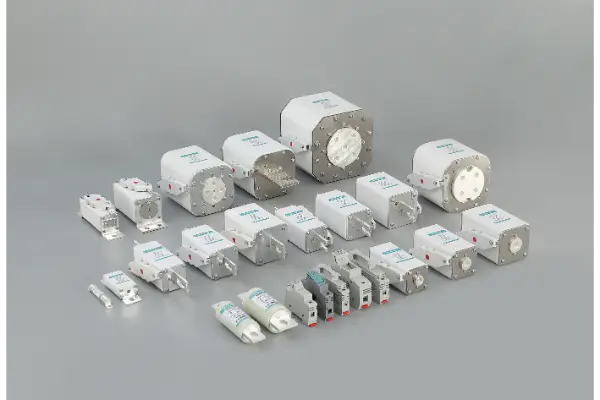
Galaxy Fuse has over 40 years of experience in fuse R&D and manufacturing, building deep technical expertise in the fast-acting fuse segment. For new energy applications such as photovoltaic inverters, DC charging stations, and energy storage converters, Galaxy Fuse offers a comprehensive range of high-performance high-speed fuses.
Energy Storage System Dedicated High-Speed Fuses are a key focus area for Galaxy Fuse. Energy storage systems demand far more from fuses than general industrial applications: DC voltages up to 1500V, short-circuit currents reaching hundreds of kiloamperes, and the need for absolute arc-extinction and interruption reliability in enclosed battery environments. Galaxy Fuse energy storage series products use pure silver fusible elements and high-purity quartz sand arc-quenching media, combined with optimized necked-structure designs, to ensure microsecond-level response and reliable interruption under extreme fault conditions.
Core Technical Advantages:
●Pure Silver / Silver-Plated Copper Elements: Low melting point and high conductivity ensure rapid response
●Optimized Necked Structure: Precise control of fusing points for consistent arc interruption
●High-Purity Quartz Sand Arc Quenching: Rapidly absorbs arc energy and suppresses restriking
●Full Certification: Products comply with IEC60269, GB13539, and other international standards, with multiple series holding UL, TUV, and CE certifications
●Complete Technical Data Support: Provides measured I²t curves and cut-off current curves, facilitating accurate system protection coordination calculations for engineers
Conclusion
The difference between fast-acting and ordinary fuses extends far beyond the surface-level "fast versus slow." From material selection and structural optimization to response mechanisms and IEC classification, the two represent entirely different protection philosophies.
Ordinary fuses protect the "thermal capacity" of cables; fast-acting fuses protect the "fragile window" of semiconductors. In today's rapidly growing new energy and energy storage sectors, understanding and properly utilizing the unique value of fast-acting fuses is an essential skill for every power electronics engineer.
Galaxy Fuse – over 46 years of commitment to high-quality fuse manufacturing, dedicated to providing safe and reliable circuit protection solutions for global new energy and energy storage systems.
For technical support on high-speed fuse selection for energy storage or new energy equipment, please contact the Galaxy Fuse technical team.