- English
- Español
- Português
- русский
- Français
- 日本語
- Deutsch
- tiếng Việt
- Italiano
- Nederlands
- ภาษาไทย
- Polski
- 한국어
- Svenska
- magyar
- Malay
- বাংলা ভাষার
- Dansk
- Suomi
- हिन्दी
- Pilipino
- Türkçe
- Gaeilge
- العربية
- Indonesia
- Norsk
- تمل
- český
- ελληνικά
- український
- Javanese
- فارسی
- தமிழ்
- తెలుగు
- नेपाली
- Burmese
- български
- ລາວ
- Latine
- Қазақша
- Euskal
- Azərbaycan
- Slovenský jazyk
- Македонски
- Lietuvos
- Eesti Keel
- Română
- Slovenski
- मराठी
- Srpski језик
- שפה עברית
- беларускі
- Bosanski
- ქართული
- O'zbek

Why Is the 750V 400A YREVq-400f EV Automotive and EVSE Fuse Essential for Reliable High-Voltage EV Protection
Modern electric vehicles and charging infrastructure demand protection devices that can safely interrupt high fault currents while maintaining reliable operation under demanding conditions. Galaxy Fuse has developed the 750V 400A YREVq-400f EV Automotive and EVSE Fuse to provide dependable circuit protection for electric vehicles, battery systems, charging equipment, and other high-voltage DC applications. Designed with fast interruption capability, low power loss, and high breaking capacity, this fuse helps improve electrical safety, extend equipment life, and reduce maintenance costs for manufacturers and system integrators.
As electric mobility continues to evolve, selecting the right high-voltage fuse has become a critical engineering decision. This article explains how the 750V 400A YREVq-400f EV Automotive and EVSE Fuse works, explores its technical characteristics, compares it with conventional protection solutions, and provides practical guidance for selecting the right fuse for EV battery packs and EV charging equipment. Whether you are an EV manufacturer, charging station supplier, or industrial equipment designer, this guide offers valuable insights for improving electrical safety and system reliability.
Contents
- Why EV Battery Protection Matters More Than Ever
- What Is the 750V 400A YREVq-400f EV Automotive and EVSE Fuse?
- Technical Specifications
- Key Features and Advantages
- Typical Applications
- How to Select the Right EV Fuse
- Comparison with Conventional Protection Devices
- Installation and Maintenance Tips
- Frequently Asked Questions
Why EV Battery Protection Matters More Than Ever
The rapid growth of electric vehicles has significantly increased the operating voltage and energy density of battery systems. Modern EV platforms commonly operate between 400V and 800V, allowing faster charging and higher drivetrain efficiency. However, these improvements also increase the potential risk of short circuits, overloads, and thermal events.
Unlike conventional automotive electrical systems, high-voltage EV circuits store substantial electrical energy. Even a brief fault can damage expensive battery modules, inverters, onboard chargers, DC/DC converters, or charging equipment if not interrupted immediately.
This is why professional-grade EV fuses are engineered with precise melting characteristics and high interrupting capacities. They isolate abnormal currents before surrounding components experience irreversible damage, helping manufacturers comply with international electrical safety standards while improving passenger safety.
For charging infrastructure, reliable fuse protection is equally important. Public charging stations operate continuously under varying environmental conditions and electrical loads. Proper fuse protection minimizes equipment downtime while protecting valuable charging modules from catastrophic failures.
What Is the 750V 400A YREVq-400f EV Automotive and EVSE Fuse?
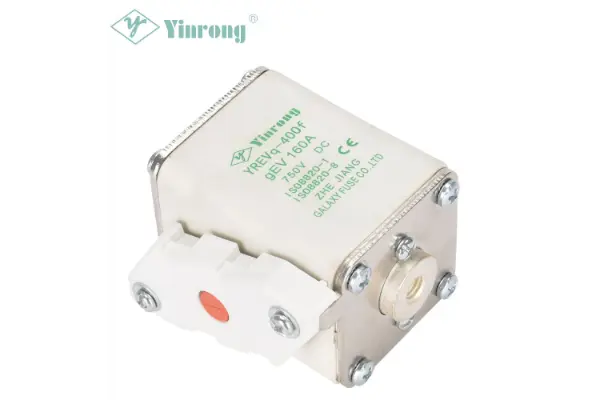
The 750V 400A YREVq-400f EV Automotive and EVSE Fuse is a high-performance DC fuse specifically designed for electric vehicles (EVs) and electric vehicle supply equipment (EVSE). It is engineered to safely disconnect fault currents in high-voltage battery circuits while maintaining excellent thermal stability during normal operation.
Manufactured by Galaxy Fuse, this fuse incorporates advanced arc-extinguishing technology, high-quality ceramic housing, premium conductive materials, and optimized fuse elements that provide accurate overcurrent protection while minimizing energy loss.
Unlike traditional industrial fuses that may not be optimized for rapid DC interruption, this specialized EV fuse is designed specifically for demanding automotive environments where vibration resistance, compact dimensions, thermal performance, and reliability are equally important.
Its high interrupting capability enables engineers to design safer battery systems without sacrificing charging performance or power delivery. The result is improved operational safety, reduced maintenance requirements, and greater confidence in high-voltage electrical architectures.
Technical Specifications
| Specification | Value |
|---|---|
| Product Name | 750V 400A YREVq-400f EV Automotive and EVSE Fuse |
| Rated Voltage | 750V DC |
| Rated Current | 400A |
| Application | Electric Vehicles & EV Charging Equipment |
| Current Type | Direct Current (DC) |
| Fuse Category | High-Speed EV Protection Fuse |
| Body Material | High-Strength Ceramic |
| Contact Material | Silver-Plated Conductors |
| Protection Function | Short Circuit & Overcurrent Protection |
| Typical Installation | Battery Pack, EVSE, Power Distribution System |
Although the exact electrical characteristics vary depending on system requirements, the fuse is designed to deliver stable protection performance throughout demanding charging cycles, rapid acceleration events, regenerative braking conditions, and continuous industrial operation.
Key Features and Advantages
Excellent High-Voltage DC Breaking Performance
Interrupting direct current is considerably more challenging than interrupting alternating current because DC arcs do not naturally pass through a zero-current point. The YREVq-400f fuse utilizes advanced internal construction to extinguish DC arcs rapidly and safely.
Fast Fault Isolation
Milliseconds matter during electrical faults. Fast interruption minimizes damage to expensive semiconductor devices including MOSFETs, IGBTs, battery management systems, power modules, and charging electronics.
Low Temperature Rise
Optimized conductive paths reduce resistance during normal operation, helping lower operating temperatures and improve overall system efficiency.
Long Service Life
Premium materials and precision manufacturing ensure consistent electrical performance over extended service periods, even in demanding automotive environments involving vibration, humidity, and frequent thermal cycling.
Compact Design
Space inside electric vehicles is limited. Compact fuse dimensions provide engineers with greater flexibility when designing battery packs and power distribution systems.
Reliable Manufacturing Quality
Every fuse produced by Galaxy Fuse undergoes strict quality inspections to ensure stable electrical characteristics, dimensional consistency, and dependable protection performance for modern EV applications.
Typical Applications of the 750V 400A YREVq-400f EV Automotive and EVSE Fuse
The growing electrification of transportation and energy systems has created a wide range of applications requiring precise and reliable overcurrent protection. The 750V 400A YREVq-400f EV Automotive and EVSE Fuse is engineered to meet these evolving demands across multiple high-voltage DC environments.
- Electric Vehicle Battery Pack Protection (EV, PHEV, HEV)
- High-Voltage Power Distribution Units (PDU)
- Onboard Chargers (OBC)
- DC Fast Charging Stations (EVSE)
- Energy Storage Systems (ESS)
- Electric Bus and Commercial Vehicle Platforms
- Industrial DC Power Systems
In each of these applications, system reliability depends on the fuse’s ability to isolate fault currents quickly without affecting surrounding sensitive components. This makes EV-grade fuses a foundational element in modern electrified systems.
How to Select the Right EV Fuse for Your System
Selecting the correct fuse for EV and EVSE applications requires careful consideration of system voltage, current load, fault characteristics, and environmental conditions. Engineers must evaluate both steady-state and transient electrical behavior to ensure optimal protection.
Key Selection Criteria
- Rated Voltage: Must exceed maximum system operating voltage (750V DC in this case)
- Rated Current: Should match continuous load requirements with safety margin
- Breaking Capacity: Must safely interrupt worst-case short-circuit current
- I²t Characteristics: Determines energy let-through during fault conditions
- Physical Size: Must fit within design constraints of battery or EVSE system
Incorrect fuse selection may lead to nuisance blowing, insufficient protection, or catastrophic system failure. Therefore, high-precision EV fuses such as the YREVq-400f are essential for modern high-power architectures.
Comparison with Conventional Protection Devices
Traditional automotive fuses and industrial protection devices are often not optimized for the unique requirements of high-voltage DC systems found in EVs and EVSE infrastructure. The table below highlights key differences between conventional fuses and the 750V 400A YREVq-400f EV Automotive and EVSE Fuse.
| Feature | Conventional Fuse | YREVq-400f EV Fuse |
|---|---|---|
| Voltage Capability | Typically below 32V–125V DC | Up to 750V DC |
| Application Scope | Low-voltage automotive systems | EV battery packs, EVSE, high-voltage DC systems |
| DC Fault Interruption | Limited arc control | Advanced high-speed arc extinction |
| Response Speed | Slower under high fault current | Ultra-fast interruption (milliseconds) |
| Thermal Stability | Moderate | High thermal cycling resistance |
| Energy Efficiency | Higher losses | Low resistance, optimized efficiency |
| EV Compatibility | Not suitable for modern EV platforms | Fully designed for EV and EVSE systems |
This comparison clearly shows why specialized EV fuses are critical in modern electrified systems. As voltage levels increase and charging speeds accelerate, conventional protection devices are no longer sufficient to ensure safe operation.
Installation and Maintenance Best Practices
Proper installation and periodic inspection of EV fuses ensure long-term reliability and system safety. While high-quality fuses like the YREVq-400f are designed for durability, correct handling is essential.
Installation Guidelines
- Ensure system is completely de-energized before installation
- Use manufacturer-recommended torque values for terminals
- Avoid mechanical stress or bending of fuse body
- Maintain proper ventilation in enclosed battery compartments
Maintenance Recommendations
- Inspect fuse connections during scheduled EV system maintenance
- Check for discoloration or thermal damage indicators
- Replace fuse only with identical specifications
- Monitor system load conditions to avoid chronic overload stress
Even though EV fuses are typically maintenance-free, periodic inspection ensures early detection of abnormal electrical conditions and helps prevent unexpected downtime.
Why High-Speed EV Fuses Are Critical for Future Mobility
The transition toward electrified transportation is accelerating globally, driven by environmental policies, technological innovation, and consumer demand. As battery capacities increase and fast-charging infrastructure expands, electrical safety requirements are becoming more stringent.
High-speed EV fuses like the 750V 400A YREVq-400f EV Automotive and EVSE Fuse are not just protective components—they are enabling technologies that allow EV systems to operate at higher voltages and power levels safely.
Without advanced fuse protection, manufacturers would be forced to limit system performance to reduce risk. With reliable high-voltage DC fuses, engineers can confidently design more powerful, efficient, and longer-range electric vehicles.
In this way, EV fuses directly support the evolution of next-generation mobility, renewable energy integration, and smart charging ecosystems.
Advanced Engineering Advantages of the YREVq-400f EV Fuse
The 750V 400A YREVq-400f EV Automotive and EVSE Fuse is not only designed for basic overcurrent protection but engineered as a precision safety component for next-generation electric mobility systems. Its internal architecture reflects a balance between electrical performance, thermal stability, and mechanical durability.
Optimized Arc Quenching Structure
One of the most critical challenges in DC circuit protection is arc suppression. During fault interruption, the fuse element melts and generates a high-energy arc. The YREVq-400f incorporates a specially designed arc-extinguishing medium that rapidly disperses energy and elongates the arc path, ensuring fast and stable interruption.
Precision-Calibrated Fuse Element
Each fuse element is manufactured with tight tolerance control to ensure predictable melting behavior. This allows engineers to design EV systems with accurate protection coordination between battery management systems (BMS), contactors, and power distribution units.
High Thermal Shock Resistance
EV environments are characterized by rapid temperature fluctuations caused by acceleration, regenerative braking, and fast charging cycles. The ceramic housing and internal filler materials are engineered to withstand repeated thermal shock without degradation.
Low Power Dissipation Design
Energy efficiency is a critical factor in EV systems. The fuse’s optimized conductive path reduces resistive losses, helping maintain system efficiency while minimizing unwanted heat generation in compact battery enclosures.
Performance Behavior in Real EV Systems
In real-world EV applications, electrical faults are highly dynamic. Short circuits may occur due to insulation failure, mechanical damage, or component aging. The performance of a fuse under such conditions determines the safety outcome of the entire system.
The YREVq-400f fuse demonstrates stable interruption behavior across a wide range of fault currents. Its response curve is designed to act selectively—allowing harmless transient surges while reacting instantly to dangerous sustained overcurrents.
This selective coordination is especially important in modern EV architectures where multiple protection layers coexist, including semiconductor protection, contactors, and battery management systems.
Engineering Value Compared to Standard DC Protection
As EV systems evolve toward higher voltage platforms (600V–800V and beyond), traditional DC protection devices struggle to meet performance expectations. The following analysis highlights the engineering advantages of the 750V 400A YREVq-400f EV Automotive and EVSE Fuse.
| Engineering Factor | Standard DC Fuse | YREVq-400f EV Fuse |
|---|---|---|
| High-Voltage Stability | Limited above 500V | Stable operation up to 750V DC |
| Fault Response Precision | Moderate accuracy | Highly calibrated response curve |
| Arc Energy Control | Basic suppression | Multi-stage arc quenching system |
| System Integration Suitability | General-purpose use | EV-specific architecture compatibility |
| Thermal Endurance | Standard industrial level | Automotive-grade thermal cycling resistance |
| Long-Term Reliability | Moderate | Extended lifecycle for EV duty cycles |
This comparison highlights why EV-grade fuse technology is becoming a standard requirement in automotive electrification projects rather than an optional component.
System-Level Integration Benefits
Beyond individual performance characteristics, the YREVq-400f fuse provides system-level benefits that improve the overall architecture of EV and EVSE designs.
- Improved battery pack safety coordination
- Reduced risk of cascading electrical failure
- Enhanced protection selectivity with BMS systems
- Improved uptime for charging infrastructure
- Better compliance with international EV safety standards
By integrating a properly rated high-voltage fuse, system designers can achieve a more robust and predictable protection hierarchy, reducing engineering complexity and improving certification efficiency.
Role in Future Electric Mobility Development
As electric vehicles transition toward ultra-fast charging, solid-state batteries, and higher voltage platforms, the role of advanced protection devices becomes even more critical. Safety margins must be maintained even as energy density and charging speeds increase.
The 750V 400A YREVq-400f EV Automotive and EVSE Fuse represents a key building block in this transformation, enabling engineers to push system boundaries while maintaining strict safety standards.
In future mobility ecosystems, high-performance fuses will not only protect systems but also contribute to intelligent energy management strategies, supporting smarter and safer transportation infrastructure worldwide.
Frequently Asked Questions (FAQ)
1. What is the main function of the 750V 400A YREVq-400f EV fuse?
The primary function of the 750V 400A YREVq-400f EV Automotive and EVSE Fuse is to protect high-voltage DC systems in electric vehicles and charging equipment by safely interrupting overcurrent and short-circuit faults before they damage critical components.
2. Can this fuse be used in all electric vehicles?
It is designed for high-voltage EV platforms operating up to 750V DC. It is widely compatible with EVs, hybrid vehicles, EV buses, and EVSE charging systems, but system engineers must always verify electrical matching before integration.
3. What makes EV fuses different from standard automotive fuses?
EV fuses are specifically engineered for high-voltage DC interruption. Unlike standard automotive fuses, they feature enhanced arc extinguishing capability, higher breaking capacity, and improved thermal resistance to handle EV battery energy levels safely.
4. Why is fast interruption important in EV systems?
Fast interruption minimizes energy exposure during electrical faults, reducing the risk of damage to battery packs, semiconductors, and power electronics. It also improves passenger safety by preventing thermal runaway escalation.
5. Can this fuse be used in EV charging stations (EVSE)?
Yes. The YREVq-400f fuse is suitable for EVSE systems including DC fast chargers, where stable high-voltage protection and rapid fault isolation are essential for continuous operation and user safety.
6. How do I know if the fuse needs replacement?
If a fuse has operated due to a fault, it must always be replaced. Physical inspection may reveal discoloration or internal damage, but electrical testing should always be performed by qualified technicians.
Safety Compliance and Industry Standards
High-voltage EV fuses must comply with strict international standards to ensure safe and reliable operation. The 750V 400A YREVq-400f EV Automotive and EVSE Fuse is designed in alignment with modern automotive electrical safety expectations, including high interrupting capacity requirements and thermal endurance standards.
Compliance ensures that the fuse can be safely integrated into OEM EV platforms and commercial charging systems while meeting global safety certification requirements for electrical protection components.
Why Choose Galaxy Fuse for EV Protection Solutions
As the demand for electric mobility grows, selecting a reliable fuse manufacturer becomes increasingly important. Galaxy Fuse focuses on delivering high-performance protection solutions for EV, energy storage, and industrial DC applications.
The company emphasizes precision engineering, consistent manufacturing quality, and rigorous testing processes to ensure that each fuse delivers stable protection under demanding real-world conditions.
- Advanced EV fuse technology development
- Strict quality control and testing systems
- Wide application coverage for EV and EVSE markets
- Reliable supply chain and engineering support
These strengths make Galaxy Fuse a dependable partner for manufacturers seeking long-term electrical protection solutions.
Conclusion
The rapid evolution of electric vehicles and charging infrastructure demands protection components that are both highly reliable and precisely engineered. The 750V 400A YREVq-400f EV Automotive and EVSE Fuse plays a critical role in ensuring system safety, efficiency, and long-term stability in high-voltage DC applications.
By combining fast fault interruption, advanced arc suppression, and automotive-grade durability, this fuse supports the next generation of electric mobility systems. It enables engineers to design more powerful EV platforms while maintaining strict safety margins.
As EV technology continues to advance, selecting the right protection device becomes not just a design choice but a fundamental requirement for system integrity. High-performance solutions like those provided by Galaxy Fuse help ensure that innovation in electric transportation continues safely and reliably.
Contact Us
If you are looking for a reliable high-voltage protection solution for your EV or EVSE project, Galaxy Fuse is ready to support your engineering needs with professional technical assistance and product solutions tailored to your system requirements.
For detailed specifications, integration support, or bulk procurement inquiries about the 750V 400A YREVq-400f EV Automotive and EVSE Fuse, please feel free to contact us today and our engineering team will provide prompt and professional assistance to help you build safer and more efficient electric systems.